Saturday, October 03, 2015

Immaculata

Following copied in its entirety from original article [with edits] from:


Picture of Immaculate Conception [Poletown] Parish from the Archdiocese of Detroit Archives

Recently, it came to our attention that the design of the Immaculate Mother was very unique. However, since the statues were a gift, the parish didn’t have any documentation on its origins or sculptor.  Thus began a very lengthy search for information!

First, we found pictures of the original statue on the altar of Immaculate Conception, both from the Library of Congress and the Archdiocesan archives.   In them, you can see the two angels holding large candles on either side of the Mary statue.  However, neither source had information on sculptor.

It took help from the Polish Art Center in Hamtramck and Robert Strybel to identify the statues’ creator.  Joanna Torchala, curator of the Kwawery Dunikowski Museum of Sculpture identified the statue.
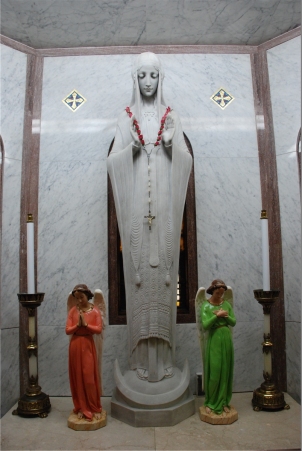
mary3
Immaculata in St. Hyacinth

The Mary statue is called “Immaculata” (the Immaculate). It was created by Paul Maximilen Landowski (1875-1961).  [Biography] The statue is dated around 1930.  A reduced form (usually around 18”) is sold in bronze at art auctions.

The name Landowski probably doesn’t ring a bell, but you certainly are familiar with his work.  His most famous work is the Christ the Redeemer statue in Rio de Janeiro, Brazil.  He also contributed to the Reformation Wall in Geneva, Switzerland.

Born in 1826, Landowski grew up in Paris, France.  He began gaining notoriety as sculptor in 1900 when he won a major competition with a statue of King David from the Old Testament.  It’s unclear how he became to be the sculptor of Immaculate Conception’s altar statues, but the date of the Immaculata coincides with the creation of the Christ the Redeemer statue.

In 1981, Fr. Skalski received three statues from Immaculate Conception before it was demolished to make room for  the GM Hamtramck plant.  This was a very controversial closure, as was the entire land acquisition for the Poletown Plant. Many people people were unwillingly displaced as the City of Detroit and GM selected the site, much of which contained a very viable neighborhood, churches, businesses and even a hospital.

There was a dedicated group of parishioners that took up residence in the church to try and prevent it from being demolished. They were finally evicted by the police. The statue was brought to Saint Hyacinth Parish for safekeeping by Father Joe Karasiewicz, the pastor of Immaculate Conception. Father Skalski, then pastor of Saint Hyacinth had one of the confesionnals converted into a side altar to display the statue of Mary.

Enjoy these pictures of the Mary statue that we’ve collected!

mary6

The Marian Shrine at St. Hyacinth


Immaculate Conception Detroit - Altar - Hoffman Studios, n.d
Immaculate Conception Parish courtesy of Hoffman Studies and the Archdiocese Archives

Immaculate Conception Detroit - Interior - Hoffman Studios, n
Immaculate Conception Parish courtesy of Hoffman Studies and the Archdiocese Archives

Immaculate Conception Detroit - Interior, n.d
Immaculate Conception Parish courtesy of the Archdiocese Archives

Following copied in its entirety from: https://sainthyacinth.wordpress.com/2015/10/03/the-imaculata-the-search-for-answers/

Other Poletown pictures at http://www.loc.gov/item/mi0157/


Friday, September 11, 2015

There's Not One Subject Not Affected By Gravity
HUMAN DESIGN ECOLOGY


THERE'S NOT ONE SUBJECT NOT AFFECTED BY GRAVITY.


Indeed.

Except ... in how it is commonplace to see people unaware of living at odds in respect to the dictates of Gravity.

Here too, Gravity is at work. Just that living with a body out of balance is at odds with how things work. For not having a clue about this significant fact is to live in default with chronic stress and pain. Short of your reasonable potential for sound health, top physical performance, and free creative expressiveness.

Design Ecology is a field of orientation toward sustainable living through seeking harmonious integration with living ecological systems. While this is typically a concern in Architectural design, it crosses over into environmental issues in areas such as Agriculture,
Energy, Human Habitation.

Human Design Ecology is a field which takes its insight from Human design itself. It's not hard to see that physiologically we are meant to breathe fresh air, to drink clean water, to eat uncontaminated foods. Psychologically, to live stress-free, in unpolluted surroundings.

In terms of considerations to Human Design Ecology, when you take the force of Gravity as an environmental factor, what do we see?

Dr. Ida P. Rolf observed: "Some individuals may perceive their losing fight with gravity as a sharp pain in their back, others as the unflattering contour of their body, others as constant fatigue, yet others as an unrelentingly threatening environment.  Those over forty may call it old age.  And yet all these signals may be pointing to a single problem so prominent in their own structure, as well as others, that it has been ignored: they are off balance, they are at war with gravity."

What to do?

Well, as you may know I am a professional instructor offering individualized training to raise the level of the body to an unstressed, effortlessly upright, balanced, easy stance. This is normal in terms of Human Anatomical design. It also honors the Laws of Physics in terms of how structures work and endure under the constant pull of Gravity.

This is something available that will be a significant benefit to people of all ages, varying backgrounds, and different levels of physical ability.

Next Steps

DISCLAIMER: This in not a pitch for you to book an appointment. 

First ... just consider the situation. See for yourself in a mirror how your body stacks up. Look at your fellows. Isn't it fascinating that with the same parts we all are put together so differently. And, how that translates to how unique we are in our movements. Our mentalities. 

Balance along the lines of Gravity won't make everybody the same. Well, maybe the same in terms of having a positive working relationship to the Gravitational field of the Earth. It will go a long way toward making a positive effect on health, productivity, performance, and creativity. 

Simply put, we are designed to live on the Earth. Why not take advantage of that great renewable, inexhaustible resource — Gravity.


Wednesday, August 05, 2015

What You Call That?

On New York City subways there's this seemingly rather common problem called "manspreading". When a fellow takes up too much room by having his legs splayed wide. There's even a poster campaign against it. This is what it looks like.


So, now, my deal is this. What do you call it when the other gender does it. Maybe not literally on the subway. Not yet, anyway. But, if you're like me and connect to Yoga and Dance pages on the social media, you begin to notice a whole bunch of photo images of yoginis and ballerinas posed with legs spread to 180 degrees. And, more. 

Doesn't anyone think it draws the male gaze? It does mine. No complaints. Just noticing a rather sharp increase in the spread eagle among the ladies. Surely someone knows we'll look.

So, now, what do we call that?
 
Here's what it might look like when all the stops are out.

Tuesday, August 04, 2015

Good Posture is Good for You

AND ...

Good Structure Enables Good Posture

Here's a nice video which makes the case for keeping good posture. Especially with all the electronic devices which have become integral to everyday living, from dawn 'til dusk.

Take a look at this short video. Then, there's something important you should know which will make all the difference. Specifically, what underlies and determines posture in the first place.


Now that you are convinced that good posture is vitally important when you stand and when you sit, I'd like to add some further understanding.

Posture means, "A position of a person's body when standing or sitting." While this is a general definition, let's expand it to include all the positions a human body can assume. Think of the exquisitely beautiful lines of the ballerina. Or, the marvelous range of possibilities demonstrated by the expert Hatha Yoga practitioner. Heck, even to eat a slice of Pizza there are a set of postures you will need to execute if you want to get that delectable from plate to pie hole.


Then, there's "Structure": 1. (Noun) The arrangement of and relations between the parts or elements and 2. (Verb) Construct or arrange according to a plan; give a pattern or organization to.

My first point is this: POSTURE IS DETERMINED BY STRUCTURE. The trunk of the palm tree can bend flexibly in the wind; an oak, no way. They share their common essential tree-ness: leaves, branches, trunk, roots. But structurally, how they are built dictates the way they move, or don't. Same with humans.

Essentially, a human being can take so many various postures; yet, there are structural constraints. For example, you can't see the back of your head. Or, try to touch your elbow to your nose. Or, a rather graphic example, you can't knee yourself in the nuts. (Thank God.)

The key distinction to be understood in respect to structure is in the area of how we humans all share the same essential structure, yet just look at all the unique individual structural differences. 

This may be a new idea to you. After all, take a look ... people are all going around with their heads and necks on top of their shoulders. The arms go here, the legs there. Your nose is not 12 inches long for a reason. If it were, it would be a foot. Mostly we register our fellows in these general terms. It takes a trained eye to discriminate the details. 

Look a little closer, and you will see what I am referring to here. So much variety in terms of how things have in fact become put together. A typically obvious one is the shoulders. It's fairly common to see one shoulder higher than the other. Or, one closer/smaller to the chest. Maybe, one more to the back or more in front than the other. 

Here is a still from a recent TV commercial. I rest my case.


Complications ensue. Such imbalances are not just local. They exist in a complex with compensations throughout the body. Notice in the image above how the neck and set of the head have accommodated the variations in the shoulder girdle. Structural issues in the pelvis/pelvic girdle are reflected in the shoulder girdle. Vice versa. The set of the legs and feet give rise to corresponding balance/imbalance in the segments higher up.

How come? The short story is that each of us is shaped by our individual history. That, adding in a mix of habits, both good and bad; unresolved traumas and accidents; insufficient training (Who taught you to stand and sit?); modelling adults around us who themselves may not have been good exemplars of proper posture and structure. Repeated postures become set in the fabric of our flesh. They become structured in owing to the ability of the soft tissue of the body to mold/take shape with repeated patterns of use.

Like the story about my Uncle Stash. He had rounded shoulders and a flat forehead. Turns out when you asked him a question he would shrug his shoulders when he didn't (very often) know the answer. When he learned the answer, he would slap his forehead. We are indeed shaped by our experience(s).

I have a trained eye and see deeply into body structures, whether standing still or in movement. To further illustrate my point about individual structural differences, why not you take a look. At how people walk. Ideally, where there are lots of people to observe. Each us learned to walk pretty much on our own. Each has history we carry along. Now look at how, even with all the same parts, there are so many individual random patterns. Some better that others. Not by my own metric of what looks good. But by the simple standard of how continued over time patterns reinforce themselves, then get fixed into the flesh. And, projecting out how some patterns down the road will lead to complications. When we see a person moving in equipoise with ease and grace, we are instinctively moved by the self evident power and presence. Why? Because it's in us to have the same. It just takes some conscious doing to make it a reality.


My other point is this. IF STRUCTURE IS IMBALANCED, THEN POSTURE IS LIMITED. For the average person this may not seem like such an issue. Most people get along well enough. Muddle through? Even here though, I would suggest considering how structural imbalances and their compensations might drain energy and limit options, even in the mundane and ordinary. And, long term, it may have a little to do with how gracefully (or not) we age. With all we do to make sure our children have every advantage in life, where is the training on the proper use of their bodies?

And then there's the other matter. That's when we turn our attention to activities in which posture is a key factor. Dance. Sports. For example, just look at all the invention and training that goes on among golfers. All the paraphernalia, all the lessons and instructions to get the perfect swing. Now consider how all that goes on without addressing the underlying unique personal limitations each player brings to the game fixed into the fabric of their flesh. It's just not on the radar. Yet.

Are we missing an opportunity because we assume that the shape [read, "structure"] we have come to identify as ourselves is somehow fixed? That's just the way I am? Born that way? 

Structure, unlike how we grow bigger and stronger as we mature, is not automatic. It is learned. Since the body is changeable, we can take advantage of that natural plasticity to move toward a place of more structural balance and integrity. 

As a Rolf Practitioner my career focus is on human structure. Restoring proper structure. Balance. Educating correct structure where it more often than not hasn't shown itself in the first place. My enthusiasm for this approach is based on the eye opening results I discovered for myself when I was looking for resolution to chronic movement problems. Also, that the work is grounded in basic science. Just like it is for any three dimensional structure on Earth, the human body must adapt to the constant pull of Gravity. Any architect or building trade worker will tell you that Gravity dictates balance around the vertical, all even and level. So too for the human body.

I guess I can't discuss subjects such as posture and structure without giving my profession a plug. I offer personalized assistance to bring the structure of the body to a vertically upright, unstressed, even, and level stance. The approach is peerless and definitive. 

If you want to live pain and stress free. Enjoy living unencumbered by past conditioning. Realizing your full potential, both physically and creatively. Then getting in balance is for you. 

First step. Do something about your posture. If you find your structure is in the way, then you may want some expert assistance.

At your service.

David D. Wronski


Friday, July 24, 2015

A "Sense" of My Old Neighborhood

I grew up in Poletown, Detroit. Most of the attenuated remnants of which are buried under a GM Cadillac Plant. The history of the razing of that neighborhood is quite a story in itself.

Part of this exercise in recollecting that place is to put in words the vivid images I still have in my mind's eye. And, nose. And, ears. Maybe, also, to put it in a way that shares the richness of it with the reader.


In previous articles I reminisced about that mecca of sweet treats, the Candy Kitchen. The parish of my baptism, Immaculate Conception and the stern Father Alexander Cendrowski, pastor during my time.


I've also mentioned such places as the Chene and Trombly Lanes, where I learned to bowl; and schoolboys worked as pin spotters. 


The Barber shop nearby on Chene where I could not for the life of me get a proper "Flat Top". But, it did have those racy magazines and tabloids. I got my first glimpse of Terry Moore, the original (to me) "sweater girl". One of those rags even had an issue tauting LSD embedded in the type on the front cover. Just soak in methyl alcohol and drink for a mind altering experience. Turns out the problem was the suggestion to use methyl alcohol; it's poisonous. No problemo with the LSD though.


The Cunningham Drug Store on the opposite corner where in my time you could still buy live leeches. And, the Rexall across the street where I often went after school to fantasize over the 8mm and 16mm movie cameras on display.


The bank on the other corner where I had a savings account and they would give me old silver dollar coins just for the asking. And, of course, for a dollar bill or equivalent. And, all nickels were Buffalo Nickels.


The shoe shine shop was down a bit from there, with several seats in a long row. And, opposite was a complete setup for hat cleaning and blocking. Men wore hats, you know.


And, further down, the magazine shop where this young lad would peruse the car magazines, and sneak a peek at the covers of the naughty ones too. 


And, props to that dry goods store where I bought my requisite khaki slacks, and the old Jewish owner would at no extra charge take them apart and resew them in the then current "pegged" style (legs tapered to the bottom). 

  
But, now I am recalling another small, but memorable piece of my growing up experience. Perhaps the most mundane.

On Milwaukee, just in from the intersection with Chene Street was the neighborhood shoe repair shop.


Photo: Michael Roper / I Lived in Detroit 

Over time I made several trips to that funky old place. What I so vividly recall was the sights and smells and sounds. The entire interior of the place looked a dark black/brown, like it had been smeared over the years with waxy shoe polish. It smelled of leather, rubber, and an exotic blend of heady aromatics evaporating from glue pots and shoe polish tins. 


As you entered, there was a customer counter on the left. Beyond, was a long, continuously running lathe-like spindle on which rotated several types of wheels; each with a dedicated purpose (and, sound): buffing, smoothing, shaping, sanding, grinding. The whole contraption was run by a large wide leather belt running off an electric motor noisily asserting its presence somewhere out of sight on the floor.


And, oh yes, all the customers' shoes were stuffed into brown bags and filed carefully on shelves high up on the wall.


That's pretty much it. How have you liked travelling for a while in my shoes?  


Monday, June 22, 2015

Chastity Stick

This is an object of high and strong social significance in a certain culture. The name in its actual language is untranslatable, and carries a wealth of meaning. 

We can call it a "Chastity Stick."

It is customary for young men and women to be chaste before marriage. When they are courting there is even a prohibition on holding hands. Instead, the "Chastity Stick" is used. The young man holding one end; the girl, the other.

The example shown is a rather detailed carving, usually intended for a couple who are near marriage age. Younger girls and boys would get one with less erotic symbolism. 

Even as simple and uncomplicated as a twig with a burl, or even a spoon.