DROPPIN' IN ON OL' AMSTERDAM
(If you know what I mean)

Photo Credit: Michele T. Fillion
I did drink some rather good beer, however (from Belgium, go figure.) By the way, in The Netherlands they tell Belgium jokes. And don't say "Holland" unless you want to be unceremoniously corrected by a stranger. The Dutch are really good at correcting an uncouth American.
For a good Dutch joke, keep reading. The place to go for the best selection of beers is called Cafe Gollem. There seems to be a designated glass for every beer they have. Try the Trappist Westvleteren 8 and 12. A beer peak experience. Hard to find, and hard to pay for. Pricey! (Santa, be a pal!)
A walk back to the hotel across Vondelpark at night is a sobering experience. Park rules are strictly enforced ... "take your garbage with you afterwards and never have intercourse near the playground. The sex must be limited to the evening hours and night." What?
The immediate purpose of my being in the original "land down under." — the whole dang place is below sea level so they have all these canals and dikes to manage the situation — was to attend the Second International Fascia Research Congress. You might wonder what a guy like me would be doing in the midst of a high level scientific research gathering in the new but rapidly emerging field of "Fascia Studies." I helped with the organization of the event and attended to give support as necessary, and to learn about the latest and best research into the human fascial system by leading researchers from around the world.
You should know that "fascia" refers to the various types of soft connective tissues from the level of the skin all the way down to bone — and, everywhere in between — form a unified body-wide matrix of support and communication. The nose bone connected to the foot bone sort of thing. It's what shapes you, man. In fact, on an entirely separate note, I heard about a discovery of why the human nose is not 12 inches long. Conclusive research shows that if it were, it would be a foot. There it was all along, right in front of our noses. (What we need more of is a firm grasp of the obvious.)
Seriously, in recent years scientific research into the human fasciae has increased markedly and the Fascia Research Congress was convened first in 2007 in Boston and recently in 2009 in Amsterdam to bring together leading edge research findings and researchers with the people in clinical fields whose therapeutic work in one way or another addresses the fascial system. The latter would be yours truly, with my long time enthusiastic practice in Dr. Ida P. Rolf Structural Integration. The goal of my work is to bring the whole body to a level of appropriate balance in gravity. That would be unlike the usual situation where you live with imbalances in the makeup of your body and suffer pains and stress and divert energy just to keep upright under gravity's constant downward pull. The body is plastic. It can change. Our theory in Structural Integration is that it is primarily the fascia — soft connective tissues — that moves and changes shape under our guided touch. The body adapts. Scientifically, however, we don't know all that much about the why's and how's of it. But the scientific understanding on that is rapidly developing.
Now, back to Amsterdam. But I need to touch a little again on the conference at VU. The conference which I have probably said more about than most people care to know was hosted at Vrije Universiteit by the VU Faculty of Human Movement Sciences. It was from here that Rembrandt conceived his painting The Anatomy Lesson of Dr. Nicolaes Tulp in 1632.
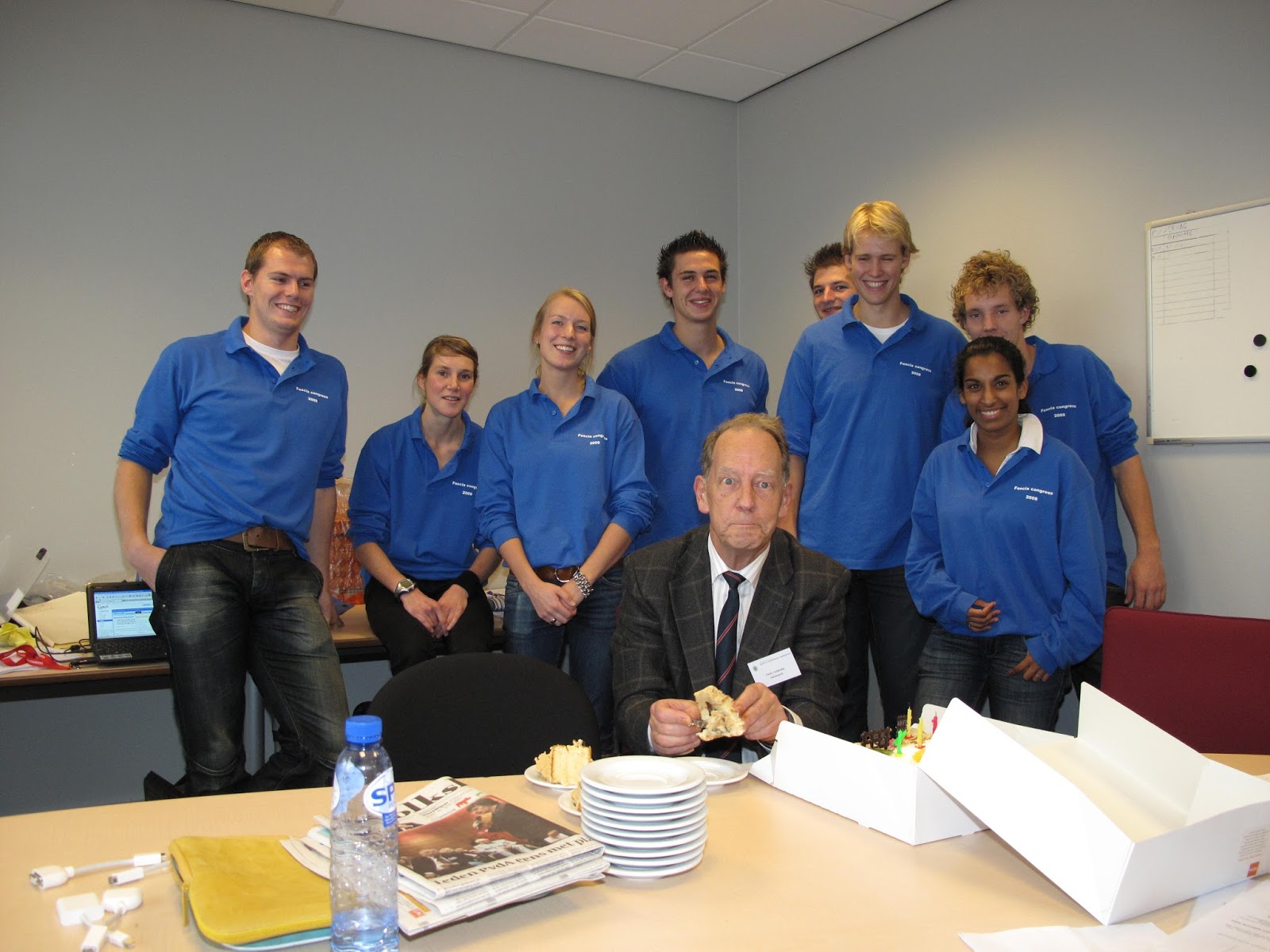
Probably the very best part of my stay in Amsterdam was being with the conference Executive Director, Professor Dr. Peter Hollander and his staff of student volunteers. It gave me great hope for the future to see such bright, enthusiastic, hard working, and caring young people so selflessly giving the necessary support in so many different ways to make the conference the success it was. More so, to see the mutual genuine respect, loyalty, and affection between Dr. Hollander and his students was most deeply touching. He celebrated a birthday during the conference and here he is with some of the students and his surprise birthday cake. (The camera caught him between smiles, I assure you.) Happy birthday, indeed, Peter!
Now to Amsterdam. For sure this time.
First impressions. There are a lot of rather tall people in The Netherlands. There is no scientific reason for this other than the almost universal love of preserved herring there. The story goes that at the very youngest ages of their children, parents hold fillets of pickled herring overhead and the kids crane upward for the morsel. Of course, this evolutionary thrust upward is not an overnight affair and it goes back centuries in that culture. It's so ingrained, in fact, just don't go into a Dutch crowd and say out loud "look up." If you don't have a herring in your hand, you could be in trouble.
Also, everyone rides a bicycle. Well, not everyone; but enough of everyone to make you notice. And mind them when crossing the street. Just like bicyclists the world over, if you stray in front of an oncoming rider, expect a good scowl, at least. (Dutch scowls are known in Europe to be the most withering.) The bikes themselves are of the rather, shall we say, "traditional" type. Very upright and simply but sturdily built. That upright posture I was told gives people the best visibility and the plain, sturdy design proves durable. (Also de regeuer for eating herring on the go.)
This is a smallish city and space is a premium. What with small apartments and walk ups many stories, the bikes stay outside. Everywhere, bikes. I even saw the classic domino-like cascading fall down of several bikes parked in the city center. I'd hate to be the one who started that. I didn't do it ... really. Really! To put them right, or to leave? That is the question. I don't need a moral dilemma in the middle of Amsterdam. For me, it would mainly be about if anyone was looking.


Then there's the canals and the quaint, antique buildings. Lots of both. The main impression is one of the coexistence of the old and the new. Old buildings on the outside, very modern styling on the inside. A lot of renovation and upgrading to modern fixtures. Interesting to see such old buildings with up to the minute contemporary window designs. The Amsterdammers give a respectful nod to the past, but certainly live in the contemporary world. Interestingly, it seems to be a thing there to show off the interior of your dwelling. Lots of windows open to view impeccably decorated living spaces.
The food. The best oysters I ever had were at the Urban Ocean. Thank you, Miriam, for that recommendation.

Here we are, Michele and me, at the Small Talk Cafe on a rainy Sunday. Friendly Dutch hospitality.
The photo above was taken for us by a patron at the Small Talk Cafe who intimated that one of the women he was with was the Queen herself! Naturally I bowed deeply with a flourish of my hat in typically chivalrous Puss 'N Boots fashion. A truly royal experience, Queen or no.
Below, some of the friendly waiters at the Small Talk Cafe. No, he's not asleep. Just relaxing in the typical Dutch fashion. Also, you should know, the US dollar has been dismal versus the Euro. That tablet next to the credit card machine is our check! An aside ... if you want to win the hearts of the locals, be sure to wear the traditional orange. That and sneakers and you won't be mistaken as a tourist. Or so I was told when I asked around if I looked like a tourist. Also, keep the city map hidden in your pocket most of the time.
When we first sat down for a bite to eat I ordered "whatever beer is popular on draft". The waiter brought me a beer, only served in a pony glass. Ha-ha. Then, returned with a complimentary pony of good Dutch gin. Nice hospitality.

For a cozy little neighborhood bistro-type meal try Gruter Cafe for the must-have dish when in The Netherlands, a warming bowl of pea soup. The Dutch insist it must be thick enough to stand a spoon. And a side of French fries... with mayo, of course. Gruter Cafe is in a rather swell part of town near where we stayed at the Park Plaza Vondelpark Hotel. Very nice buffet breakfast at the hotel. First class. The coffee in this town makes Starbucks look like has-beans. What we call espresso is their standard cup of Joe. Mas Sabore!
Lastly, I would be remiss to not drop a line about candy. It's called Drop. There is a hint to that topic in my title, after all. Drop is mainly licorice, but also comes in every possible type of flavor, color, shape, and texture. There is a chain of stores named Jamin where dozens of various forms and flavors of Drop are sold by the scoopful out of self serve bins. But there is also the definitive candy store, and the high point of my tourist experience of Amsterdam.
In a beautiful old neighborhood called the Jordaan, we found The Old Dutch Candy Store. Or, as the locals call it, "Het Oud-Hollandsch Snoepwinkeltje." The Dutch language can be a mouthful, but I prefer a mouthful of Drop. Or, maybe the language sounds the way it does because all those folks are speaking whilst enjoying a Drop or two. I am writing a research grant proposal and intend to go back and take a really good look at that when the funding arrives.
But back to the shop. As soon as I entered the door I began to time travel to my elementary school days. Go with me now on this journey into a time nearly forgotten. We enter the store and see the lovely and kind proprietor, Mariska Schaefer, patiently fishing out from countless jars of Drop just a few pieces of this and a piece or two of that for four little children. Each one has just a few pennies to spend on their choice of candy treats.
When I was a boy there were a few "Mom and Pop" candy stores on the way home from school. Even then, licorice was my go to favorite. Those and other candies were displayed loose and unwrapped, sold a piece or two for a penny. I have a very vivid memory of the fascination and thrill of peering into the glass candy case and trying to make up my mind on just what to choose with my budget of 5 cents. And the shopkeeper at one store who did not disguise his impatience with having to deal with such a trivial matter as a kid buying a few pennies worth of candy.
Not so the beautiful Mariska, however. A model of patience and love. Somehow I think those children got a little bit more for their money than just a few pieces of candy. She did tell us, however, that even she has her limits. When the line of young customers gets particularly long, she is known to sometimes (threaten to) make her "personal selection" so that things move along in good time when the deliberation goes overtime. Another lesson ... as we would say back in the tri-state area (New York/New Jersey/Connecticut) ... "Hey, kid, it's only candy; so hurry up already!"
The Old Dutch Candy Store will ship to your door, and I am probably going to have Ms. Schaefer send me her personal selection and enjoy the surprise when it arrives. No clinkers in this store. Everything is good. But beware the licorice known as DZ, Double Zout. That's "double salt" and it can make your whole body pucker up so that you drop down a shoe size or two. An acquired taste. Try some, but not a lot at first until you see whether it is to your taste.
While we were in the store a local cat moseyed on in and snuggled up for a snooze in an empty box under the one of the displays. The cat was black with white paws and we called it the "licorice cat." There is a form of licorice called "katzen" and another especially tasty type that looks like a black tube filled with a white fondant showing at the ends. I am not a cat person; but I am a Krazy Kat for licorice.
The Old Dutch Candy Store has a website and is gearing up to sell online. Meanwhile you can wire transfer some Euros and Mariska Schaefer will personally fill your order. As I write this the level of my two kilos of Drop is slowly coming down. My tele-psychic adviser sees an overseas order in my future.
Some say that I have a tendency to go fictional in my reportage. Hey, I never said I guaranteed the veracity of my words. But when it comes to kids in candy stores, I hold myself to strict standards of truth. See for yourself. Those are the kids I was talking about. The one in front is not a Kewpie doll. So don't ask.

FINI

Also, everyone rides a bicycle. Well, not everyone; but enough of everyone to make you notice. And mind them when crossing the street. Just like bicyclists the world over, if you stray in front of an oncoming rider, expect a good scowl, at least. (Dutch scowls are known in Europe to be the most withering.) The bikes themselves are of the rather, shall we say, "traditional" type. Very upright and simply but sturdily built. That upright posture I was told gives people the best visibility and the plain, sturdy design proves durable. (Also de regeuer for eating herring on the go.)
This is a smallish city and space is a premium. What with small apartments and walk ups many stories, the bikes stay outside. Everywhere, bikes. I even saw the classic domino-like cascading fall down of several bikes parked in the city center. I'd hate to be the one who started that. I didn't do it ... really. Really! To put them right, or to leave? That is the question. I don't need a moral dilemma in the middle of Amsterdam. For me, it would mainly be about if anyone was looking.


Then there's the canals and the quaint, antique buildings. Lots of both. The main impression is one of the coexistence of the old and the new. Old buildings on the outside, very modern styling on the inside. A lot of renovation and upgrading to modern fixtures. Interesting to see such old buildings with up to the minute contemporary window designs. The Amsterdammers give a respectful nod to the past, but certainly live in the contemporary world. Interestingly, it seems to be a thing there to show off the interior of your dwelling. Lots of windows open to view impeccably decorated living spaces.
The food. The best oysters I ever had were at the Urban Ocean. Thank you, Miriam, for that recommendation.

Here we are, Michele and me, at the Small Talk Cafe on a rainy Sunday. Friendly Dutch hospitality.
The photo above was taken for us by a patron at the Small Talk Cafe who intimated that one of the women he was with was the Queen herself! Naturally I bowed deeply with a flourish of my hat in typically chivalrous Puss 'N Boots fashion. A truly royal experience, Queen or no.
Below, some of the friendly waiters at the Small Talk Cafe. No, he's not asleep. Just relaxing in the typical Dutch fashion. Also, you should know, the US dollar has been dismal versus the Euro. That tablet next to the credit card machine is our check! An aside ... if you want to win the hearts of the locals, be sure to wear the traditional orange. That and sneakers and you won't be mistaken as a tourist. Or so I was told when I asked around if I looked like a tourist. Also, keep the city map hidden in your pocket most of the time.
When we first sat down for a bite to eat I ordered "whatever beer is popular on draft". The waiter brought me a beer, only served in a pony glass. Ha-ha. Then, returned with a complimentary pony of good Dutch gin. Nice hospitality.

For a cozy little neighborhood bistro-type meal try Gruter Cafe for the must-have dish when in The Netherlands, a warming bowl of pea soup. The Dutch insist it must be thick enough to stand a spoon. And a side of French fries... with mayo, of course. Gruter Cafe is in a rather swell part of town near where we stayed at the Park Plaza Vondelpark Hotel. Very nice buffet breakfast at the hotel. First class. The coffee in this town makes Starbucks look like has-beans. What we call espresso is their standard cup of Joe. Mas Sabore!
Lastly, I would be remiss to not drop a line about candy. It's called Drop. There is a hint to that topic in my title, after all. Drop is mainly licorice, but also comes in every possible type of flavor, color, shape, and texture. There is a chain of stores named Jamin where dozens of various forms and flavors of Drop are sold by the scoopful out of self serve bins. But there is also the definitive candy store, and the high point of my tourist experience of Amsterdam.
In a beautiful old neighborhood called the Jordaan, we found The Old Dutch Candy Store. Or, as the locals call it, "Het Oud-Hollandsch Snoepwinkeltje." The Dutch language can be a mouthful, but I prefer a mouthful of Drop. Or, maybe the language sounds the way it does because all those folks are speaking whilst enjoying a Drop or two. I am writing a research grant proposal and intend to go back and take a really good look at that when the funding arrives.
But back to the shop. As soon as I entered the door I began to time travel to my elementary school days. Go with me now on this journey into a time nearly forgotten. We enter the store and see the lovely and kind proprietor, Mariska Schaefer, patiently fishing out from countless jars of Drop just a few pieces of this and a piece or two of that for four little children. Each one has just a few pennies to spend on their choice of candy treats.
When I was a boy there were a few "Mom and Pop" candy stores on the way home from school. Even then, licorice was my go to favorite. Those and other candies were displayed loose and unwrapped, sold a piece or two for a penny. I have a very vivid memory of the fascination and thrill of peering into the glass candy case and trying to make up my mind on just what to choose with my budget of 5 cents. And the shopkeeper at one store who did not disguise his impatience with having to deal with such a trivial matter as a kid buying a few pennies worth of candy.
Not so the beautiful Mariska, however. A model of patience and love. Somehow I think those children got a little bit more for their money than just a few pieces of candy. She did tell us, however, that even she has her limits. When the line of young customers gets particularly long, she is known to sometimes (threaten to) make her "personal selection" so that things move along in good time when the deliberation goes overtime. Another lesson ... as we would say back in the tri-state area (New York/New Jersey/Connecticut) ... "Hey, kid, it's only candy; so hurry up already!"
The Old Dutch Candy Store will ship to your door, and I am probably going to have Ms. Schaefer send me her personal selection and enjoy the surprise when it arrives. No clinkers in this store. Everything is good. But beware the licorice known as DZ, Double Zout. That's "double salt" and it can make your whole body pucker up so that you drop down a shoe size or two. An acquired taste. Try some, but not a lot at first until you see whether it is to your taste.
While we were in the store a local cat moseyed on in and snuggled up for a snooze in an empty box under the one of the displays. The cat was black with white paws and we called it the "licorice cat." There is a form of licorice called "katzen" and another especially tasty type that looks like a black tube filled with a white fondant showing at the ends. I am not a cat person; but I am a Krazy Kat for licorice.
The Old Dutch Candy Store has a website and is gearing up to sell online. Meanwhile you can wire transfer some Euros and Mariska Schaefer will personally fill your order. As I write this the level of my two kilos of Drop is slowly coming down. My tele-psychic adviser sees an overseas order in my future.
Some say that I have a tendency to go fictional in my reportage. Hey, I never said I guaranteed the veracity of my words. But when it comes to kids in candy stores, I hold myself to strict standards of truth. See for yourself. Those are the kids I was talking about. The one in front is not a Kewpie doll. So don't ask.

FINI
PS ... It was the end of October and a neighborhood bike shop featured this image on a outside wall ...

Oh...the Dutch joke. Remember I was discussing fascia before, and in the Dutch language sometimes things can get lost in translation. Have a laugh.
PPS ... If you still want more, CLICK here to get some culinary tales from the Amsterdam trip.
PPS ... If you still want more, CLICK here to get some culinary tales from the Amsterdam trip.